milestone
CSCI · GR / GRADUATE SEMINAR / Fall 2026
AI for
Software Engineering
A graduate course on how recent advances in AI lead to innovative automated practices in software engineering. Participants investigate AI techniques for SE process automation, study transformative impacts across the software lifecycle, and are introduced to research at the AI4SE intersection.
The course atlas / 20 meetings
A semester built as a
research argument.
Four connected arcs move from model fundamentals to systems, assurance, and a research position students can defend.
01
Arc I
Models, agents, and evidence
Establish the technical vocabulary of code models, then learn to read agent results and benchmarks without overclaiming.
- 01
Lecture + discussion
LLMs for code: foundations and evaluation
Tokenization, pretraining, fill-in-the-middle, pass@k, and contamination-aware evaluation.
- 02
Lecture + benchmark reading
Autonomous SE agents and SWE-bench
ReAct loops, agent anatomy, the Agent-Computer Interface, and what SWE-bench results do and do not establish.
- 03
Paper clinic
Benchmark reading clinic
Trace a headline result back to its task definition, sampling protocol, baselines, and threats to validity.
In development - 04
Lecture + concept map
Neural code representations
Tokens, trees, and graphs; CodeBERT, GraphCodeBERT, CodeT5, and representation choices for code retrieval.
- 05
Seminar
Repository-scale context and retrieval
How systems select, rank, and compress the evidence a model needs to reason across a codebase.
In development
02
Arc II
Generation, change, and repair
Move from isolated completion to changes that must respect a repository, a specification, and executable feedback.
- 06
Lecture + repair trace
Automated program repair
Fault localization, patch generation, validation, overfitting, and the shift from search-based to LLM-based repair.
- 07
Design studio
Code generation under constraints
Specifications, types, tests, repository conventions, and feedback loops as constraints on generated code.
In development - 08
Lecture + test audit
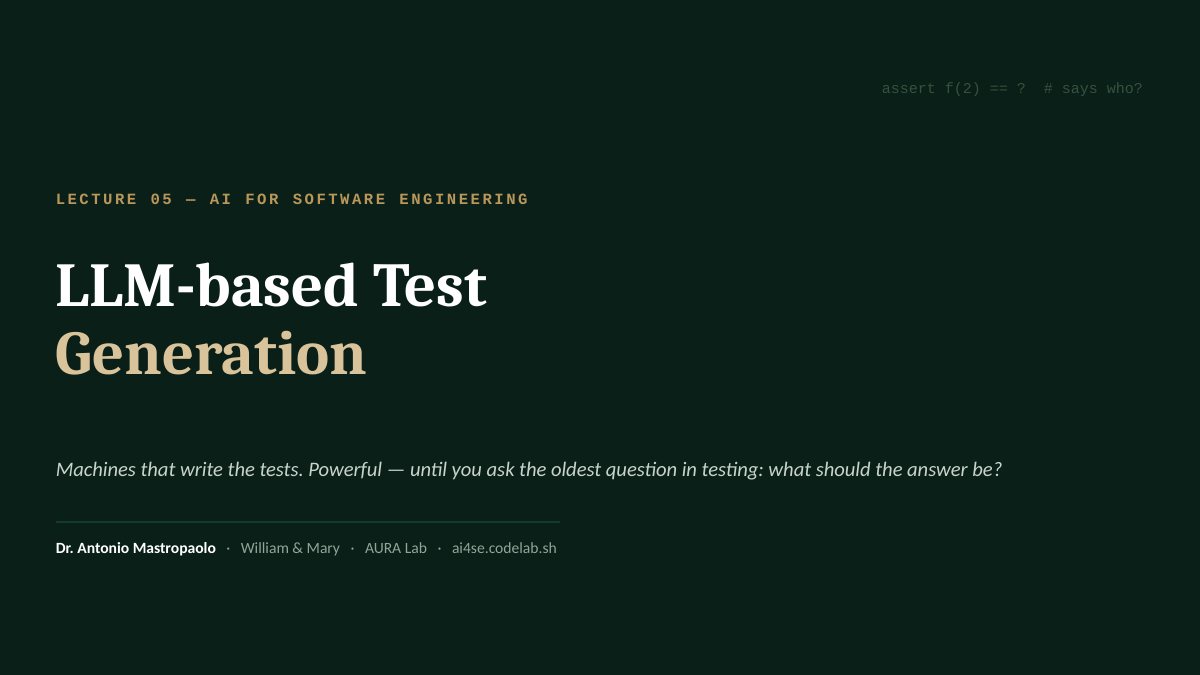
LLM-based test generation
The oracle problem, TestPilot, CoverUp, TestGen-LLM, and why coverage alone does not establish test quality.
- 09
Lecture + critique
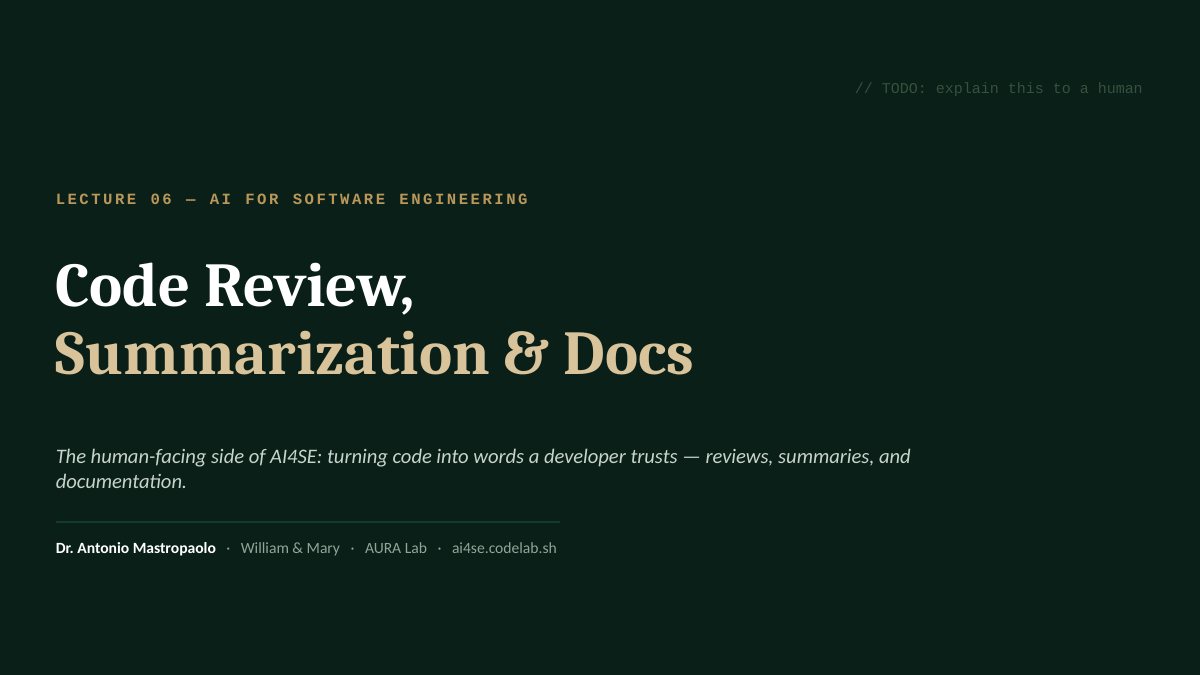
Code review, summarization, and documentation
Generating developer-facing language, judging usefulness, and designing evaluation beyond lexical similarity.
- 10
Lecture + case study
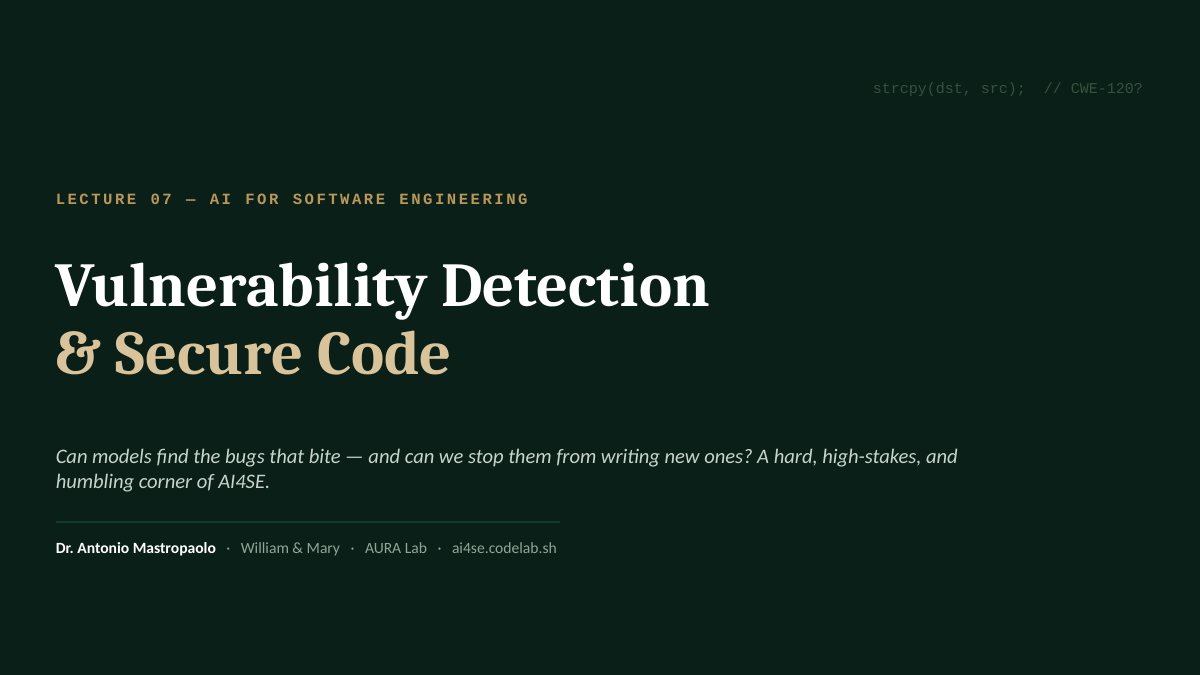
Vulnerability detection and secure code
Learning-based detection, the lab-to-reality gap, secure generation, and hybrid static-analysis plus LLM systems.
03
Arc III
Assurance, people, and trust
Study where automated evidence is strong, where it breaks, and how developers decide whether to act on it.
- 11
Systems seminar
Static analysis meets language models
Pair deterministic program facts with model judgment while keeping claims traceable to evidence.
In development - 12
Trajectory lab
Tool use and agent-computer interfaces
Shells, editors, browsers, sandboxes, and the interface decisions that shape agent reliability.
In development - 13
Metrics workshop
Evaluation beyond pass@k
Mutation score, calibration, cost, latency, human review burden, and the metrics a deployment decision actually needs.
In development - 14
Research discussion
Human factors in AI-assisted development
Productivity, trust, skill transfer, oversight, and the difference between faster output and better engineering.
In development - 15
Replication studio
Replication clinic
Reconstruct a published experiment and identify the decisions that determine whether its result will reproduce.
In development
04
Arc IV
Research practice
Turn an interesting observation into a defensible AI4SE study, then improve it through critique and replication planning.
- 16
Research studio
From observation to research question
Frame a consequential gap, name the unit of analysis, and separate a research question from a product pitch.
In development - 17
Methods workshop
Designing AI4SE experiments
Baselines, ablations, sampling, power, qualitative evidence, and threats to validity.
In development - 18
Build session
Student research studio
Develop the study artifact, evaluation plan, and evidence chain with in-room technical review.
In development - 19
Peer review
Peer review and revision
Review claims, methods, and reporting as a program committee would, then revise against the strongest objection.
In development - 20
Research forum
A defensible AI4SE agenda
Synthesize the semester into a research position: what should be automated, how should it be measured, and who benefits.
In development
Already on the desk
The first seven lecture decks.
The seminar method
Read. Inspect.
Build a claim.
- 01Read the result
Start with a consequential AI4SE claim and understand the system behind it.
- 02Inspect the evidence
Trace datasets, baselines, metrics, and validity threats before accepting the headline.
- 03Build what changes your mind
Use code, replications, and critique to produce evidence that can withstand review.
Course diary